 An official website of the United States government.
  Official websites use .gov
A .gov website belongs to an official government organization in the United States.
Official websites use .gov
A .gov website belongs to an official government organization in the United States. Secure .gov websites use HTTPS
A lock or https:// means you’ve safely connected to the .gov website. Share sensitive information only on official, secure websites.
Secure .gov websites use HTTPS
A lock or https:// means you’ve safely connected to the .gov website. Share sensitive information only on official, secure websites.We investigated the role that the mesophotic coral ecosystems of Pulley Ridge (off the southwest coast of Florida) played in replenishing key coral, sponge, algal, and fish species in the downstream reefs of the Florida Keys and Dry Tortugas. Because of the well-documented decline of Florida’s reefs, it is important to identify, protect, and manage sources of larvae that can help sustain Florida’s reef ecosystems and the tourism economy that depends on it.
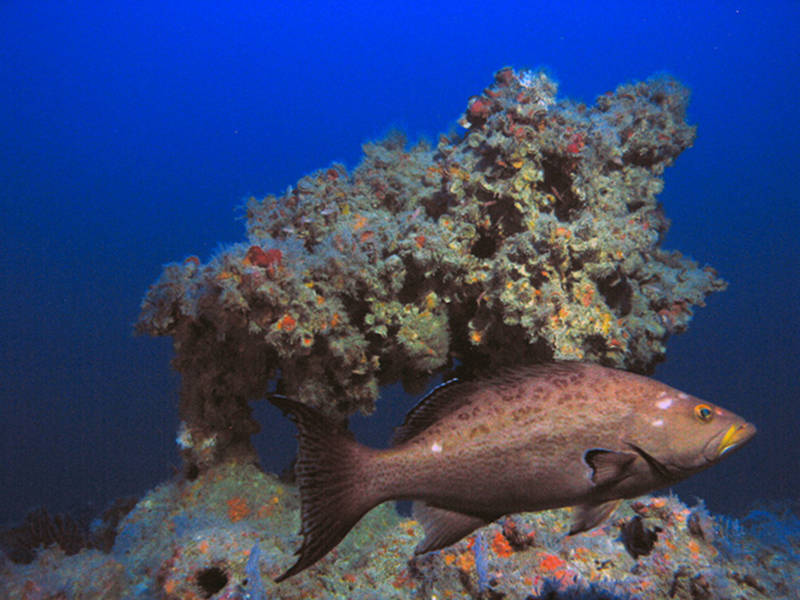
Deep reefs, referred to as mesophotic coral ecosystems, can be found from 100–330+ feet (30–100+ meters) in the eastern Gulf of Mexico. Pictured is a scamp grouper, Mycteroperca phenax, 320 feet (98 meters) deep off the Dry Tortugas. Credit: Cooperative Institute for Exploration, Research, and Technology.
Why We Care
The coral reef ecosystems of the southeast United States provide habitat, food, and shelter to hundreds of species of fishes and invertebrates. Their economic role in supporting our commercial fisheries, tourism, and recreational industries is also considerable. In addition to their aesthetic value, coral reefs provide structural buffers from storms and currents along the highly populated southeast Florida coast.
Observations of relatively healthy deeper reefs, also referred to as mesophotic coral ecosystems, on Pulley Ridge (250 km (155 mi) west of Cape Sable, Florida) raised questions as to the ecological role they may play in the replenishment of shallow and other mesophotic coral ecosystems, such as in the Florida Keys and Dry Tortugas. Pulley Ridge, the deepest known photosynthetic community off the U.S. continental shelf, is located at depths of 59 to 105 meters (194 to 344 feet). In an era of rapid coastal ocean changes, it is important to understand the degree of connectivity between Pulley Ridge, a comparatively healthy coral ecosystem, and other coral ecosystems located downstream.
What We Did
We:
- evaluated the potential population connectivity of organisms between the Pulley Ridge mesophotic coral ecosystem and the reefs of the Florida Keys and Dry Tortugas,
- assessed the community composition and structure of the Pulley Ridge and Dry Tortugas mesophotic coral ecosystems, and
- determined the ecosystem value of Pulley Ridge and evaluated the costs/benefits of specific management alternatives.
Working collaboratively with federal, state, and nongovernmental stakeholders, we ensured our results were directly relevant and understandable by resource managers to inform current and future management decisions pertaining to the reefs of Pulley Ridge, the Dry Tortugas, and the Florida Keys.
Our research spanned an array of disciplines focused on: the physical characteristics of the region (physical oceanography and biological modeling), the biology and ecology of the resident species (population genetics, population dynamics, and community structure), the economic valuation of ecosystem services (e.g., fisheries) that Pulley Ridge supports, and a cost-benefit analysis of specific management alternatives (bio-economics).
We conducted seven research cruises from 2012–2015 on the mesophotic coral ecosystems of Pulley Ridge and the Dry Tortugas: four on the RV Walton Smith and three on the MV Spree. We characterized the habitat based on 237 hours of video (using a remotely operated vehicle with a high-definition camera) covering a distance of 150 km (93 mi) and conducted 270 SCUBA dives to collect samples and service instruments. In addition to fieldwork, we conducted laboratory-based studies, and modeled physical oceanography, biophysical processes using the Connectivity Modeling System, and ecosystem value. Our focal species for genetic connectivity analyses and biophysical modeling were red grouper (Epinephelus morio), the Indo-Pacific lionfish (Pterois spp.), bicolor damselfish (Stegastes partitus), the great star coral (Montastraea cavernosa), and the giant barrel sponge (Xestospongia muta). For calicified green algae (Halimeda spp.) and lettuce corals (Agaricia spp.) not enough information was collected for genetic connectivity, so we instead looked at diversity and species boundaries (as their taxonomy and systematics are complex), respectively.
This work was part of the Regional Ecosystem Prediction Program and funded by NCCOS and the Office of Ocean Exploration and Research in collaboration with the Office of National Marine Sanctuaries, National Marine Fisheries Service’s Southeast Regional Office, and the Gulf of Mexico Regional Collaboration Team. It was led by Robert Cowen, University of Miami, and represented a collaboration of more than 25 scientists at nine different universities and two federal laboratories (NOAA’s Atlantic Oceanographic and Meteorological Laboratory and Southeast Fisheries Science Center) pooling their expertise through NOAA’s Cooperative Institute for Marine and Atmospheric Studies at the University of Miami in coordination with the Cooperative Institute for Ocean Exploration, Research, and Technology at Florida Atlantic University.
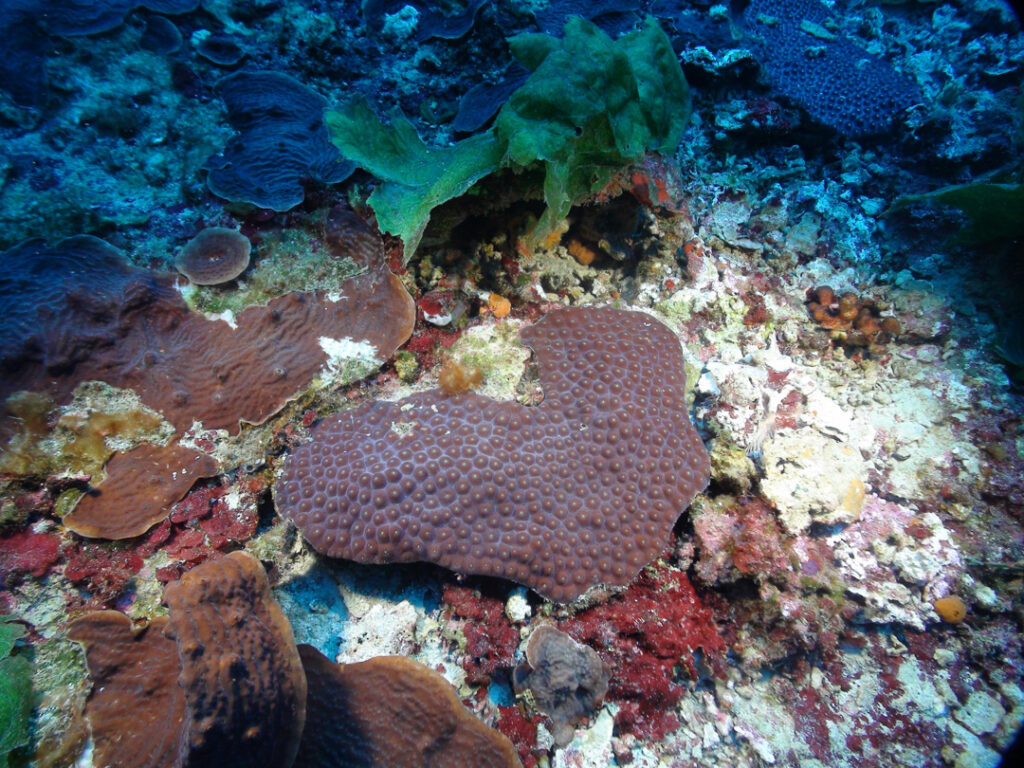
The great star coral, Montastraea cavernosa, and lettuce corals, Agaricia spp., at Pulley Ridge are two of our project’s focal species for understanding connectivity between Pulley Ridge and the Florida Keys. Credit: Mike Echevarria, Florida Aquarium.
What We Found
We found that the reefs of Pulley Ridge, the Dry Tortugas, and the Florida Keys are:
- Physically connected by oceanic currents. Prior to this project, the Loop Current (the predominant current in the Gulf of Mexico) was only known to release eddies that move westward within the Gulf of Mexico. We documented that the Loop Current also releases anticyclonic eddies that move eastward along the Cuban coast and northward along the shelf break of the southwest Florida Shelf, bringing warm waters over the reefs of Pulley Ridge, the Dry Tortugas, and the Florida Keys.
- Well-connected for fishes. For fishes, we found red grouper, bicolor damselfish, and lionfish populations living at Pulley Ridge, the Dry Tortugas, and the Florida Keys have the same genetic makeup. The management implication is that reef fish species should be managed as a single population for these reefs.
- Well-connected for the great star coral, but not the giant barrel sponge. There is evidence that the great star coral, Montastraea cavernosa, is well dispersed throughout these reefs resulting in genetically connected populations between Pulley Ridge and reefs > 15 meters (49 feet) in the Florida Keys. In contrast, the giant barrel sponge, Xestospongia muta, showed evidence of limited larval exchange or connection between Pulley Ridge and the Dry Tortugas and no connectivity with the Florida Keys. Thus, for the giant barrel sponge, self-recruitment dominates (vs. receiving larvae from other reefs).
We learned that the mesophotic coral ecosystems of Pulley Ridge:
- Consist of three unique geographically distinct habitat areas. Species diversity and dominance varies on Pulley Ridge resulting in a mesophotic coral ecosystem with three distinct areas: the Main Ridge, Central Basin, and West Ridge. In general, Pulley Ridge is algal-dominated (48%), with low scleractinian (1.4%) and sponge cover (1.3%).
- Are dominated by red grouper pits, which support both small forage fish species and an increasing population of lionfish.
- Have declined in hard coral cover in the past 10 years, but show signs of recovery. There has been a 93% decline in hard coral cover in the past ten years. However, the new hard coral area discovered in 2014 in the Central Basin has high densities of small plate corals (Agaricia) suggesting a recent recruitment event.
- Supports significant reproductive output of a common fish species. The bicolor damselfish, Stegastes partitus, at Pulley Ridge was found to grow more slowly, but live longer and attain larger overall size, and invest more energy into reproduction (providing offspring with a better chance of survival) than those found in shallower reefs in the Florida Keys.
Video of Pulley Ridge Mesophotic Coral Ecosystem
(posted on January 18, 2018) Credit: Coral Ecosystem Connectivity Expedition, 2014.
Benefits of Our Work
In June 2018, the Gulf of Mexico Fishery Management Council voted to expand the Pulley Ridge Habitat Area of Particular Concern to include the new coral area we discovered in 2014. Results of our work are also being used by managers to gain a better understanding of the underlying processes that regulate Pulley Ridge and how Pulley Ridge helps sustain the coral reef communities in the Florida Keys and Dry Tortugas.